Recording studios have a curious habit of ending up in places that were never meant to be recording studios, sometimes producing a masterpiece, sometimes a very expensive lesson about buildings, and occasionally both.
Why Musicians Have Spent Decades Moving the Studio Closer to the Way They Actually Live
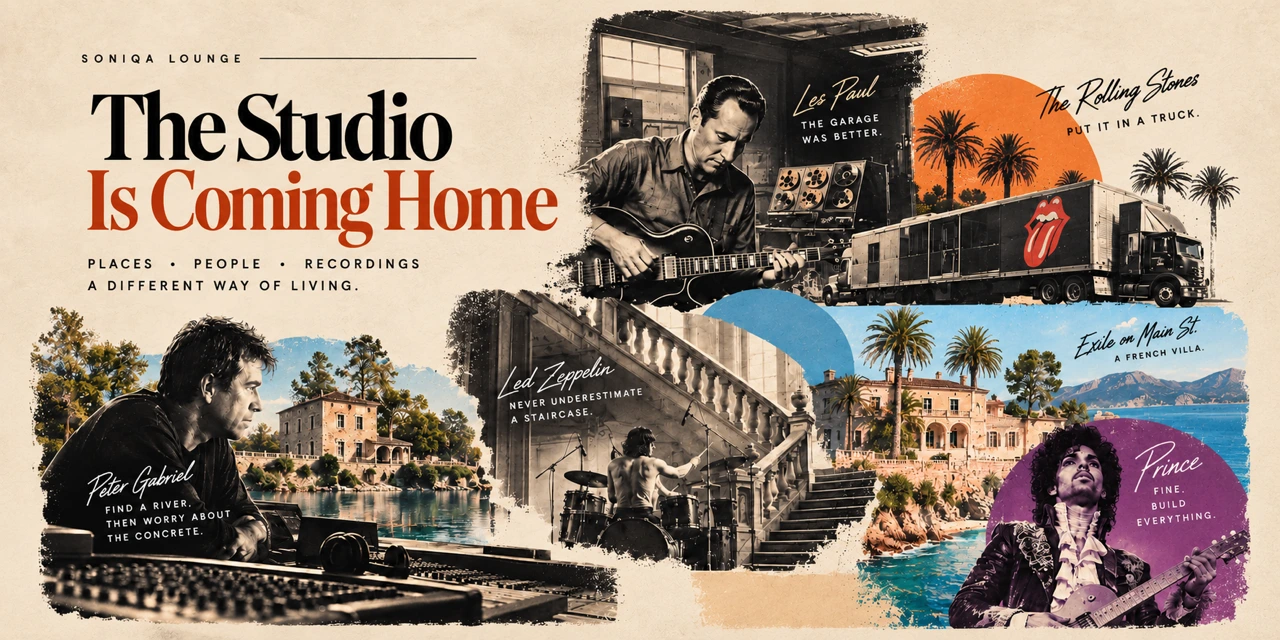
Les Paul: The Garage Was Better
In the 1940s, Les Paul built a recording studio in the garage of his Hollywood home, not because home recording was cheaper, but because he wasn't satisfied with what conventional recording could do.
The garage became his laboratory for overdubbing, microphone placement, echo, delay and eventually multitrack recording, helping to change the way records could be made.
The home studio, in other words, did not begin as a compromise because somebody couldn't afford the real thing, it began because, for Les Paul, the real thing wasn't good enough.
Not a bad start.
The Rolling Stones: Put It in a Truck
By the beginning of the 1970s, the Rolling Stones had a different problem. Mick Jagger wanted to record at his Stargroves country estate, but transporting an entire studio's worth of equipment there was hardly practical, so Ian Stewart helped arrive at a wonderfully straightforward alternative: put the studio in a truck.
The Rolling Stones Mobile Studio could travel to wherever the musicians wanted to work, effectively reversing the traditional relationship between artist and recording studio: instead of taking the band to the studio, they could take the studio to the band.
It was an unusually sensible solution to a very rock-and-roll problem.
From Les Paul's Garage and the Rolling Stones' Truck to Staircases, Villas, Mills and Kitchens
Led Zeppelin: Never Underestimate a Staircase
The mobile studio also helped make one of rock's most famous recording accidents possible.
At Headley Grange, Led Zeppelin discovered that the enormous entrance hall and staircase gave John Bonham's drums an extraordinary character. Engineer Andy Johns placed microphones on the stairway above Bonham's kit, and the building itself became part of the recording.
The resulting sound on When the Levee Breaks became one of the most recognisable drum sounds in rock history, despite the fact that one of its most important acoustic components was essentially a staircase that nobody had designed for recording.
“This must be slightly irritating for acousticians.”
The Stones Again: The French Villa
For Exile on Main St., the Rolling Stones Mobile Studio travelled south to Villa Nellcôte, Keith Richards' rented mansion on the Côte d'Azur, which sounded like an almost suspiciously good idea: Mediterranean climate, beautiful surroundings and no conventional recording-studio timetable.
The villa was magnificent. The basement was rather less cooperative.
It was hot, humid and hardly designed for recording, so musicians and instruments ended up scattered between rooms while cables wandered through the house and the mobile unit sat outside. Richards later recalled experimenting throughout the basement, moving instruments between spaces to find the right echo and resonance.
By most sensible measures, it was not an ideal studio, but it did help produce Exile on Main St., which makes the argument rather inconvenient.
“Sometimes bad architecture and good music appear capable of reaching an understanding.”
What Prince, Peter Gabriel, Joni Mitchell, Steve Albini and Jay Kay Discovered About Where Creative Work Happens
Prince: Fine, Build Everything
Prince approached the problem rather differently. Instead of adapting a house or parking a truck outside it, he built an entire creative world of his own.
When Paisley Park opened outside Minneapolis in 1987, it brought recording studios, rehearsal and performance spaces, offices and film production facilities together under one roof. Prince could write, record, rehearse and shoot without organising his life around someone else's studio schedule.
Most home-studio advice does not begin by suggesting that the reader acquire around 65,000 square feet, and there are probably sound financial reasons for this.
Prince had simply taken the original home-studio idea to its logical, if slightly extravagant conclusion: instead of fitting the studio into his life, he built a place where his life and the studio no longer needed separating.
Peter Gabriel: Find a River, Then Worry About the Concrete
Peter Gabriel began with another requirement when looking for the future home of Real World Studios: he wanted water.
After considering several sites around Bath, most of them old mills, he found a former mill complex in Box with a river running underneath it, combining the scale he needed with the kind of environment he wanted to create.
Then the practicalities began.
So much concrete was required for acoustic isolation that the building had to be underpinned and given new foundations, which is a useful reminder that creative inspiration occasionally has structural consequences.
In this case the trouble was worthwhile, because Real World developed into a recording environment known not only for its equipment and acoustics, but for the experience of actually working there.
Joni Mitchell: Actually, the Kitchen
Perhaps the most useful story comes from Joni Mitchell.
When Musician magazine visited her in 1995 specifically to photograph her home studio, she posed in front of the mixing console and then explained that she hardly ever went into the room. If they really wanted to photograph where she created music, she suggested the kitchen, with her small Collings guitar.
It is difficult to imagine a more concise review of a studio by its owner, and there is a useful lesson hiding inside it: however impressive the equipment and however carefully designed the room, none of it matters very much if you would rather be somewhere else.
Steve Albini: Through the Kitchen, Up the Stairs
Steve Albini's early Chicago home studio presented the opposite problem, because he certainly used it, although doing so required a certain amount of domestic navigation.
The recording rooms were in the basement while the control room was in the attic, which meant that musicians wanting to hear playback had to go upstairs, pass through the kitchen and then climb another flight of stairs.
It worked, although having the kitchen between the musicians and the control room was probably not a feature worth preserving.
Albini eventually built Electrical Audio as a purpose-designed facility, taking what he had learned from the limitations of adapting a house and applying it to a building designed specifically for recording.
Jay Kay: Choose the House for the Studio
By the late 1990s, Jay Kay had arrived at an idea that sounds remarkably contemporary.
After enjoying the communal atmosphere of residential recording while making Travelling Without Moving, he decided he wanted something similar at home, reportedly sketching the idea for his future facility during a transatlantic flight before returning to Britain and looking for a country property that could become both home and studio.
He eventually found Chillington, where an existing building beside the swimming pool could be converted, and later made the logic of the purchase unusually clear: the gardens and pool were nice, but the real reason for buying the property was that it had enough space for the studio.
For once, the studio was not squeezed into the house after the property decision had been made, it was part of the reason for choosing the property in the first place.
“Choosing the house around the studio suddenly sounds suspiciously sensible.”
Why Choosing the Right Home Can Sometimes Matter as Much as Choosing the Right Room
And If Home Happens to Be on the Mediterranean…
After garages, trucks, staircases, French villas, mills, kitchens and the occasional 65,000-square-foot solution, a pattern begins to emerge: musicians have always tried to make the studio fit their lives rather than making their lives fit the studio.
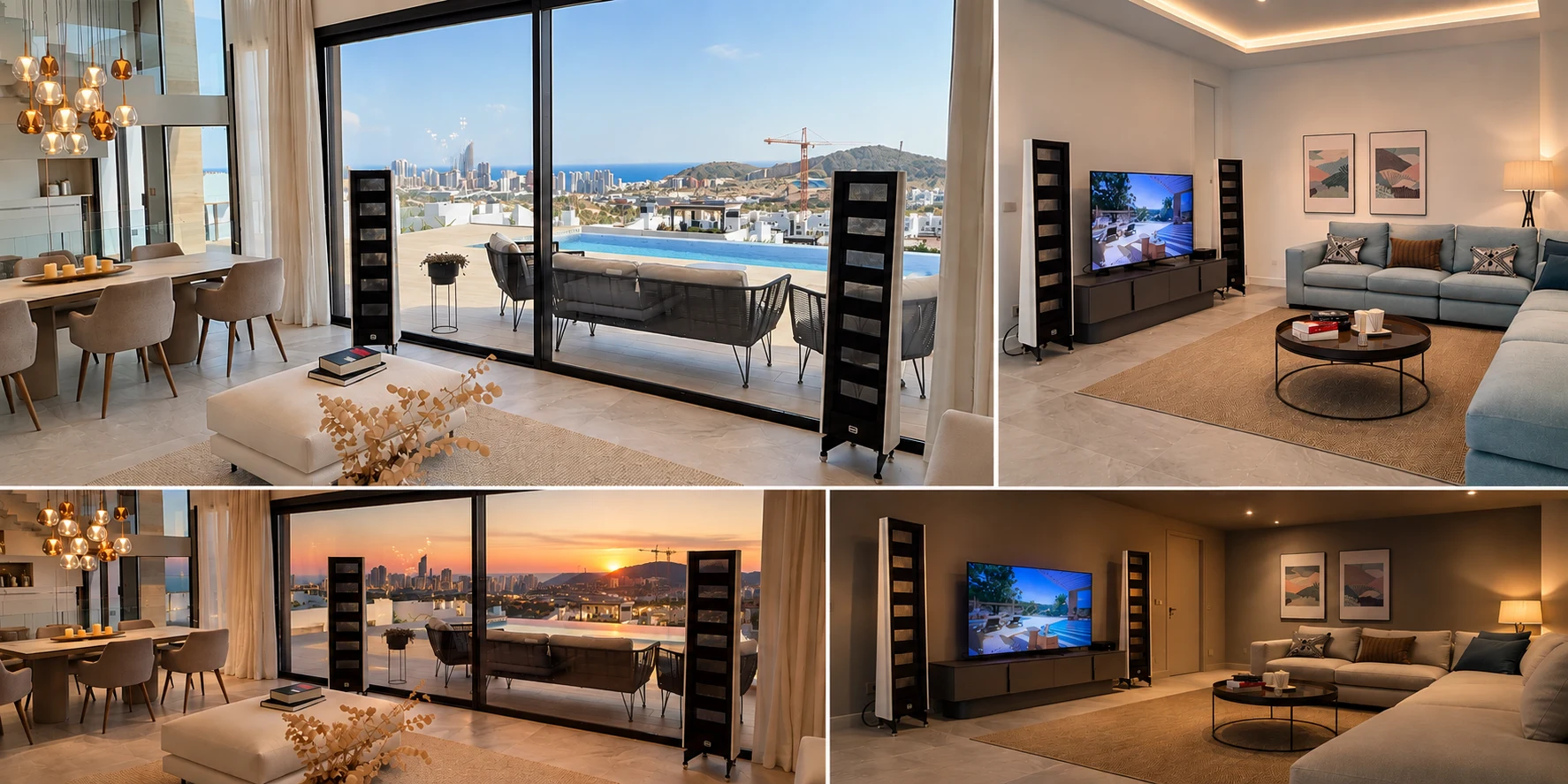
A second home on the Spanish Mediterranean is simply another variation on the same idea. For a music professional, it might become a second creative space, while for someone who simply loves music, perhaps it becomes the listening room they always wanted.
At Costa Soniqa, we know what happens when people who care about music start looking at floor plans. The architect may see a basement, the developer another bedroom, while we tend to see possibilities, particularly when the home is still off-plan and nobody has yet put a wall, a socket or an air-conditioning unit exactly where it shouldn't be.
And because this is Spain, there is one more advantage: you should occasionally want to leave the studio.
After eighty years of garages, trucks, staircases, villas, mills and kitchens, perhaps the lesson is simple: the best studio belongs in a home you actually want to be in.
If opening the door happens to reveal the Mediterranean, so much the better.
Where Would You Put Yours?
Les Paul chose a garage. The Rolling Stones chose a truck. Led Zeppelin found a staircase, Joni Mitchell preferred the kitchen, while Prince needed rather more space. The interesting part was never simply where they put the studio, but why they wanted it there. Perhaps that is the question worth asking about your own home: where does music belong in the way you actually live? For some, the answer may be a serious studio, for others a dedicated listening room — and sometimes it is simply a space where music gets the attention it deserves.