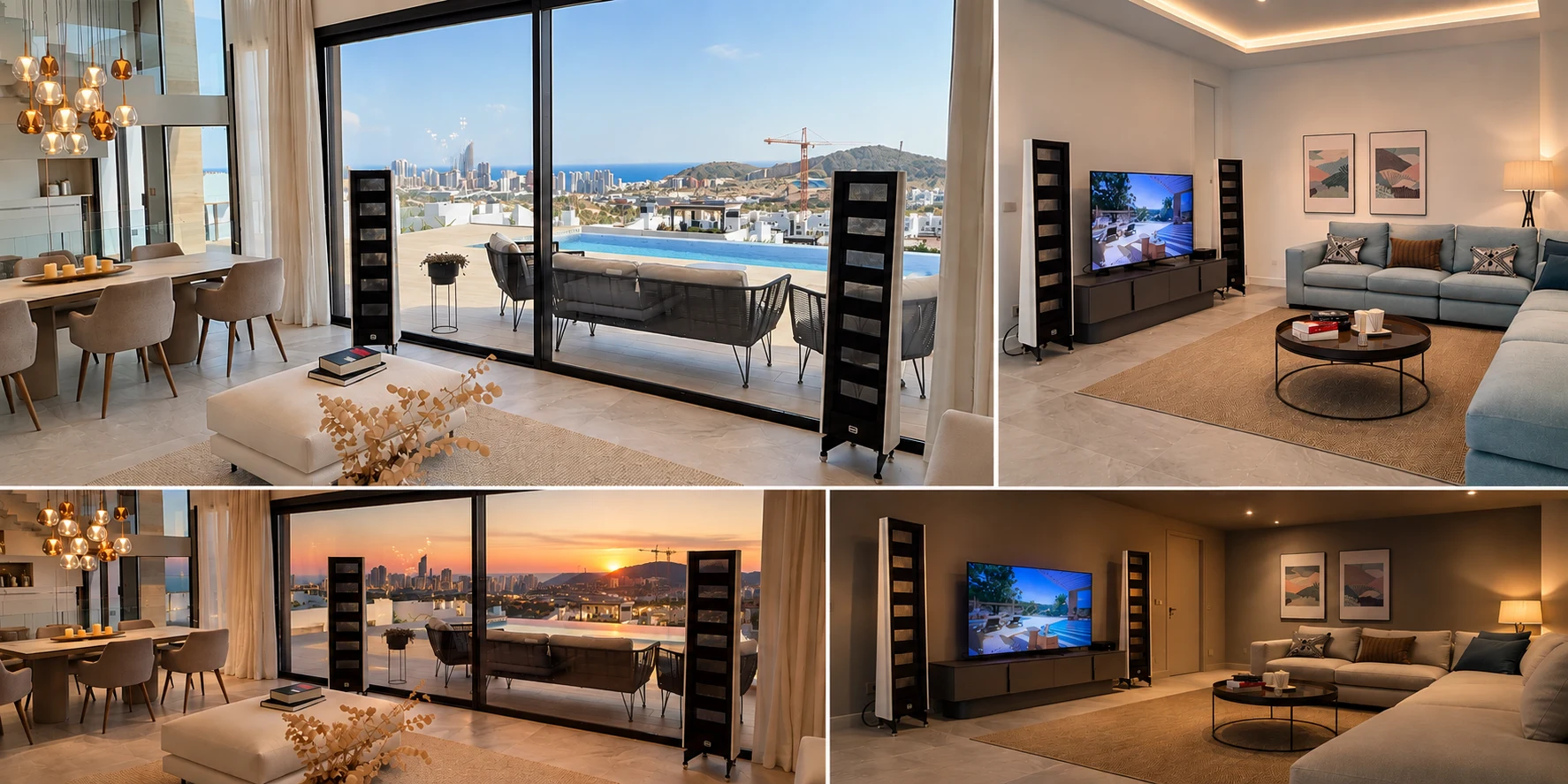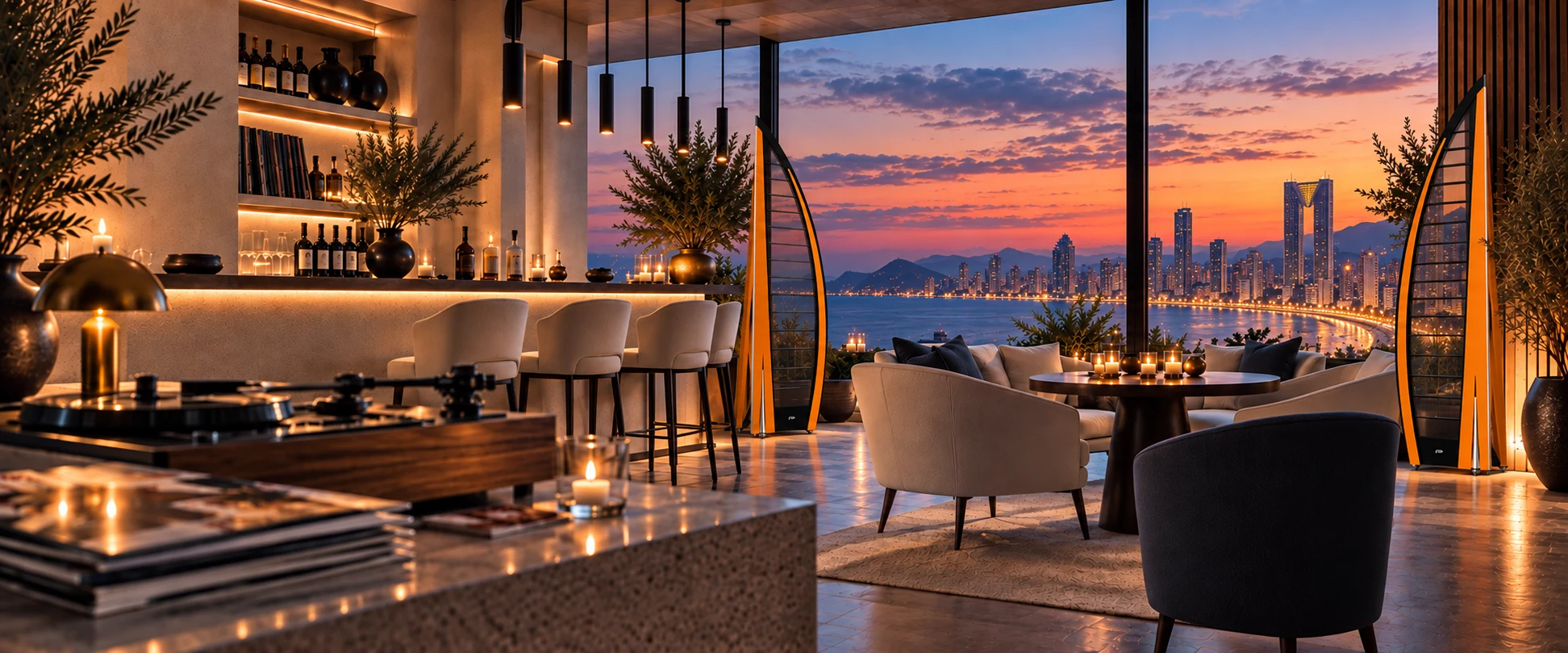
Robert Lucskai has spent almost three decades around audio and, since 2008, much of his professional life around property. We talked to the founder of Costa Soniqa about what makes good sound matter, how international buyers are changing what they expect from a home in Spain — and why architecture, technology and audio may need to start speaking the same language.
What Makes Good Sound Matter
When did good sound become more than just music for you?
Probably much earlier than I realised.
I have always been fascinated by the difference between hearing music and actually experiencing it. You can know a recording for years, then hear it through a truly exceptional system and suddenly discover space, texture and emotion that you never knew were there.
Once you experience that, curiosity takes over. You start wondering why one system can make a recording feel completely believable while another, despite doing everything apparently correctly, leaves you strangely unmoved.
Hi-Fi gives us an impressive vocabulary for describing sound.
We talk about resolution, dynamics, transparency, tonal balance, imaging, transient response and plenty of other things that can be genuinely useful.
“I want music to feel real. That is a rather less scientific measurement, but after almost thirty years I have found it surprisingly reliable.”
Do audiophiles sometimes forget about the music?
Of course. I have done it myself.
You change something, move a loudspeaker a few centimetres and suddenly find yourself listening to the hi-hat instead of the song. At some point it is probably worth remembering why you bought the system in the first place.
Then again, moving the loudspeaker those few centimetres really can make a surprising difference.
This is an inconvenient hobby.
The Systems You Never Forget
How did Spain become part of the story?
I came to Spain through real estate, but staying here became about much more than work.
There is something about Mediterranean life that suits me. The sea is obviously part of it, but so are cycling, swimming, being outdoors and the amount of life that happens beyond the walls of the house.
I also like the international character of the Spanish coast. You meet people from completely different countries, cultures and professions who have all arrived here by different routes.
Many came initially for a holiday. Then they began spending a few months here. Eventually Spain became a much more significant part of their lives.
That changes what people expect from a property too. A second home may gradually become somewhere you spend three, four or six months of the year. At that point, compromises that seemed perfectly acceptable for two weeks in August begin to feel rather different.
What International Buyers Expect from Modern Homes
Has working with international property buyers changed the way you look at homes?
Very much.
When you work with property, particularly with international buyers, you realise how differently people define a good home.
Some are looking for architecture and design. Others care enormously about the kitchen, outdoor space or privacy. Someone else wants a proper home cinema, excellent sound or technology that simply works without requiring a manual every time they arrive back in Spain.
And expectations have changed.
People are used to increasingly sophisticated technology in almost every other part of their lives. It is reasonable for them to expect a newly built home to understand lighting, climate, shading, security, entertainment and connectivity rather better than homes did twenty years ago.
The interesting part is that these things are still often treated as separate extras.
I think that will change.
What do you think buyers will expect from the next generation of Mediterranean homes?
Less technology that looks technological.
That may sound contradictory, but I think we are already moving in that direction.
People want more capability, not necessarily more devices. They want lighting that works naturally, climate that keeps the house comfortable, reliable connectivity, good television and cinema, music where they want it and simple control over everything.
They don't necessarily want to see how any of it works.
And international buyers bring another interesting factor. The house has to be intuitive. Guests need to understand it. Family members need to understand it.
Someone arriving after several months away should not need twenty minutes to remember which app controls the blinds.
A modern home can contain a remarkable amount of technology. That doesn't mean living in it should feel technical.
Why Developers Have a New Opportunity
Does that change the job of the developer as well?
I think it creates an opportunity.
The fundamentals will always come first: location, architecture, construction quality, light, space and the relationship between inside and outside.
But buyers increasingly compare homes on another level too. They notice how easily the property works.
And some decisions become much easier when they are made during design and construction rather than afterwards.
Developers don't need to turn every property into a technology demonstration. In fact, I think that would be a mistake. A home should not require a guided tour of its control system.
But creating the infrastructure and flexibility for lighting, shading, climate, audiovisual systems, connectivity and control gives the eventual owner far more freedom.
The clever part is providing possibilities without forcing everybody into exactly the same solution.
Visible and Invisible Audio
The Hi-Fi industry has spent decades making equipment more visible. Why are you interested in making some of it disappear?
Because I like both.
Some loudspeakers deserve to be seen, and the best of them can have the presence of sculpture. I certainly wouldn't want a world in which every piece of audio equipment disappeared into plasterboard.
But I also don't believe every room needs to announce that it contains an audio system.
We now have architectural loudspeakers, hidden subwoofers and integration technology capable of producing very serious results without dominating the interior. That opens good sound to people who would never consider a conventional Hi-Fi system.
“The interesting question isn't whether audio should be visible or invisible. It is whether it belongs there.”
Does that mean architectural audio and traditional high-end Hi-Fi are moving closer together?
I think they should.
For a long time they have almost behaved like separate industries. Traditional Hi-Fi focused on the dedicated system and specialist customer. Custom installation focused on distributing technology throughout the property.
There is no particularly good reason the two worlds shouldn't learn from each other.
Someone may want discreet music throughout the house and still have a pair of extraordinary loudspeakers in the room where they really listen. Another person may want almost everything hidden. Someone else may want a cinema that becomes invisible when nobody is watching a film.
The technology allows all of those things.
What interests me is the freedom to choose rather than having the category make the decision for you.
So why aren't homes already designed this way?
Partly because several industries have to meet in the same building.
Architects understandably think about architecture. Interior designers think about space, materials and furniture. Developers have budgets, schedules and construction realities to manage. Integrators think about technology. The audio industry thinks about sound.
The loudspeakers, unfortunately, are often invited into the conversation rather late.
All of them can be excellent at what they do. The difficulty is often the space between them.
A decision that looks insignificant on an architectural plan can matter enormously to an audiovisual system later. Equally, there is no point designing technically perfect audio if it destroys the interior designer's concept.
Nobody wins that argument. Especially not the person who bought the house.
Where Property, Technology and Sound Meet
Is that where your property and audio backgrounds finally meet?
Yes. Although it took me a surprisingly long time to realise that they belonged together.
I have worked in international real estate since 2008 and with premium property on the Spanish coast since 2014. At the same time, audio and audiovisual technology have been part of my life for almost thirty years.
For years they were essentially two parallel worlds. Eventually it became difficult to ignore how relevant one was to the other.
The people buying exceptional properties in Spain are often exactly the people who appreciate good design, good technology and good sound. Yet those conversations traditionally happen with different companies, often at completely different stages of the project.
There seemed to be a missing connection.
So where does Costa Soniqa fit into all this?
Costa Soniqa probably exists because I eventually stopped trying to keep those worlds separate.
It isn't about turning every home into a Hi-Fi showroom or filling buildings with technology.
It is about understanding what the property is supposed to become, then bringing the right people and disciplines together around that.
Architects understand architecture. Interior designers understand space and materials. Developers understand how to deliver homes. Integrators understand technology. The high-end industry understands sound.
We work with specialists in those different areas. My role is often to connect the dots and keep the experience coherent from the client's point of view.
One last question. When is an audio system finished?
I'm not sure you should ask an audiophile that.
Exploring what the next generation of Mediterranean homes could become?
Discover how Costa Soniqa brings architecture, technology and exceptional sound together around the way you want to live.